Controls
- Steer
- ← → or A / D
- Start / retry
- Enter or Space
- Pause
- P or Esc
On touch, hold the left or right half of the screen to steer, and tap to start.
How a run works
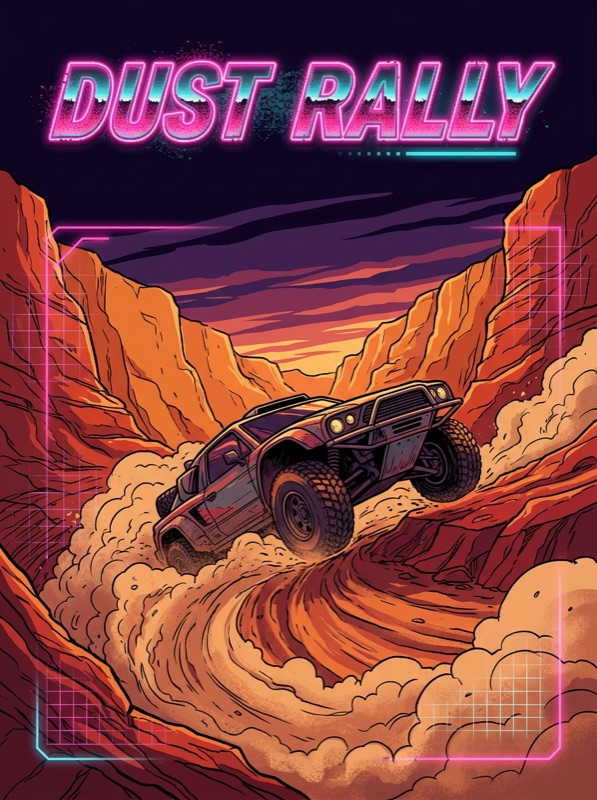
Your car stays near the bottom of the screen while the canyon scrolls toward you. Touching either canyon wall or any rock ends the run instantly. There is no finish line; the score is simply how far you get and what you collect on the way.
The car's speed is automatic. It rises as the stage gets harder, and a nitro can pushes it higher for a few seconds.
How scoring works
| Source | Points |
|---|---|
| Distance | 1 point per metre |
| Checkpoint (every 500 m) | +150 |
| Nitro can | +250 and 2.6 s of nitro |
Notice the weight of the cans. One can is worth as much as 250 metres of driving, and they appear every 85 to 160 metres. On a strong run, more of the score comes from cans than from distance.
How it gets harder
Difficulty is tied to distance, not time, and reaches its maximum at 1,200 m — a little over half a minute of clean driving. Over that stretch:
- The road narrows from 300 px wide to 172 px.
- The bends swing further from side to side.
- Rocks come roughly 40% closer together.
- Your cruising speed rises by about two-thirds.
After 1,200 m nothing ramps further, so a run that survives the first stretch is a test of consistency rather than of an ever-rising difficulty curve.
Strategy
Chase every can
At 250 points each, cans are the whole game. It is worth a small risk to collect one, and their pickup area is generous — wider than the car itself.
Don't hoard nitro
Nitro stacks, but only up to five seconds. Grabbing a can with more than 2.4 seconds already banked wastes some of the boost (you still get the 250 points). Nitro is also safer than it looks: difficulty depends on distance, not speed, and the car steers harder the faster it goes.
Steer before the bend
The car takes about 0.15 seconds to reach full sideways speed after you press a direction. At high speed that is most of a car length, so start turning into a bend slightly before it arrives.
The next gap is near the last one
Rocks are placed so that each one sits at most half a road-width sideways from the previous rock, and never closer than 46 px to a wall. Look for the lane beside the last rock you passed; the next opening is almost always close by.
The rocks are smaller than they look
Collision with rocks is checked against a box slightly smaller than the drawn sprite, and the walls are only tested at three points along the car with a couple of pixels of leeway. Tight squeezes succeed more often than instinct says they will.
Good to know
- On touch screens, hold anywhere on the left or right half of the screen to steer. Holding both halves cancels out.
- The game pauses if the window loses focus.
- Your best score is stored in this browser only.
More games
- Neon Drift — arcade racer
- Sector Seven — vertical shooter
- Shock Breaker — brick breaker
- Volt Serpent — snake